Why your SEO numbers stopped making sense, and what to measure instead

Google started rolling out another core update while we were writing this. Of course it did…
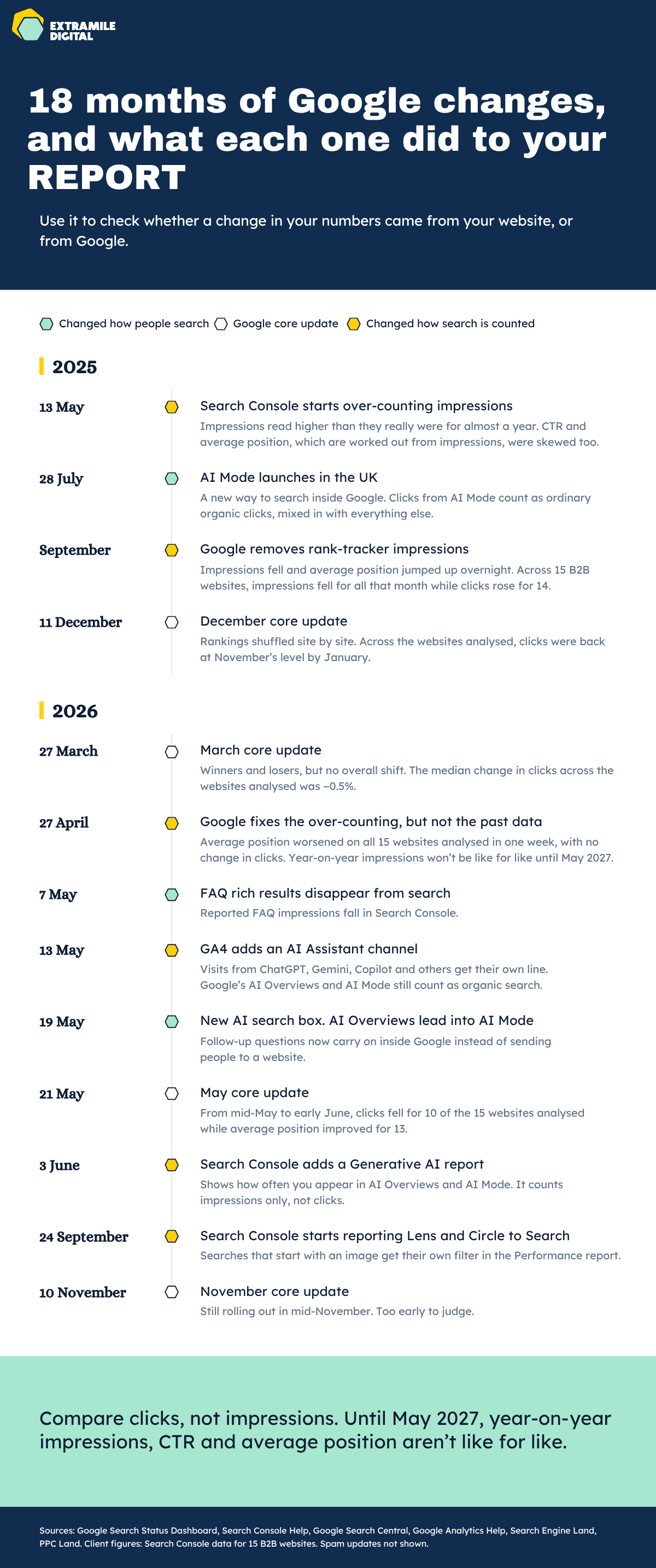
By our count, that’s 13 big changes to how search works, or how it’s counted, since May 2025. Five of them arrived within a single month, and that’s not including the almost bi-daily spam updates. If keeping up has started to feel like a part-time job, you’re not imagining it. It’s part of ours.
You’ve probably seen the effects in your monthly report, which has started to read like a riddle. Rankings up. Impressions down. Clicks down further. And nobody in the meeting is quite sure which number to trust.
We’ve been tracking these changes as they’ve landed, flagging them in our clients’ reports and adjusting their SEO and AI search strategies as we go. We’ll keep doing that, because Google clearly isn’t going to slow down.
Some of the drop in the numbers is real, and some of it is Google changing how it keeps score; knowing which is which is half the job. So we researched and compared SEO data across 15 different B2B websites to separate the two. Here’s what we found, and what we’d measure from now on.
What we found across 15 B2B websites
We compared August to October 2026 with the same months in 2025, using Google Search Console and GA4. The 15 websites are mostly B2B manufacturers, engineers and chemical businesses.
- Organic clicks fell on 13 of the 15, by a median of 21%.
- Reported average position improved on 9 of the 15. The median moved from 14.6 to 12.5.
- It now takes 77 impressions to earn one click, up from 65 a year earlier.
- AI assistants such as ChatGPT sent visits to all 15 websites, but only about 2.5% as many as organic search.
On paper, these businesses rank as well as they did, and often better. They’re being seen. They’re getting conversions. They’re just being clicked on less.
People are still searching, they’re just clicking less
In April 2025 we wrote about Gartner’s forecast that traditional search would shrink by 25% by 2026. We said at the time that, even if it did, Google would still handle the vast majority of searches. It still does. The searching stayed. The clicking left.
SparkToro’s 2026 analysis found that 69.5% of Google searches in the UK end without a click, the highest rate of the six countries it measured. So the UK is top of the table for not clicking. Out of every 1,000 UK searches, 232 clicks reach a website outside Google.
Demand itself has held up. Datos data reported by Search Engine Land shows searches per user fell by nearly 20% in the US over a year, but by only 2-3% in Europe.
The biggest single reason is AI Overviews. Ahrefs found that when one appears, the top organic result gets 58% fewer clicks. It isn’t only those results either. Seer Interactive’s data shows click-through rates down 41% in a year on searches with no AI Overview at all.
Why your position can improve while your traffic falls
This is the part that catches most people out. A better average position used to mean more traffic. It no longer does.
Google’s own documentation says an AI Overview occupies a single position in the results, and every link inside it is given that position. If your datasheet is cited in an AI Overview at the top of the page, Search Console records a top position for it, whether or not anyone clicks. Congratulations, technically.
Ahrefs’ research adds the other half. Only 38% of pages cited in AI Overviews also rank in the top 10, so a result from page two can be recorded near the top.
We saw exactly this. Of the 12 websites whose clicks fell in October, six had a better average position than a year before.
The numbers themselves changed, twice
Some of what looks like a change in performance is really a change in counting.
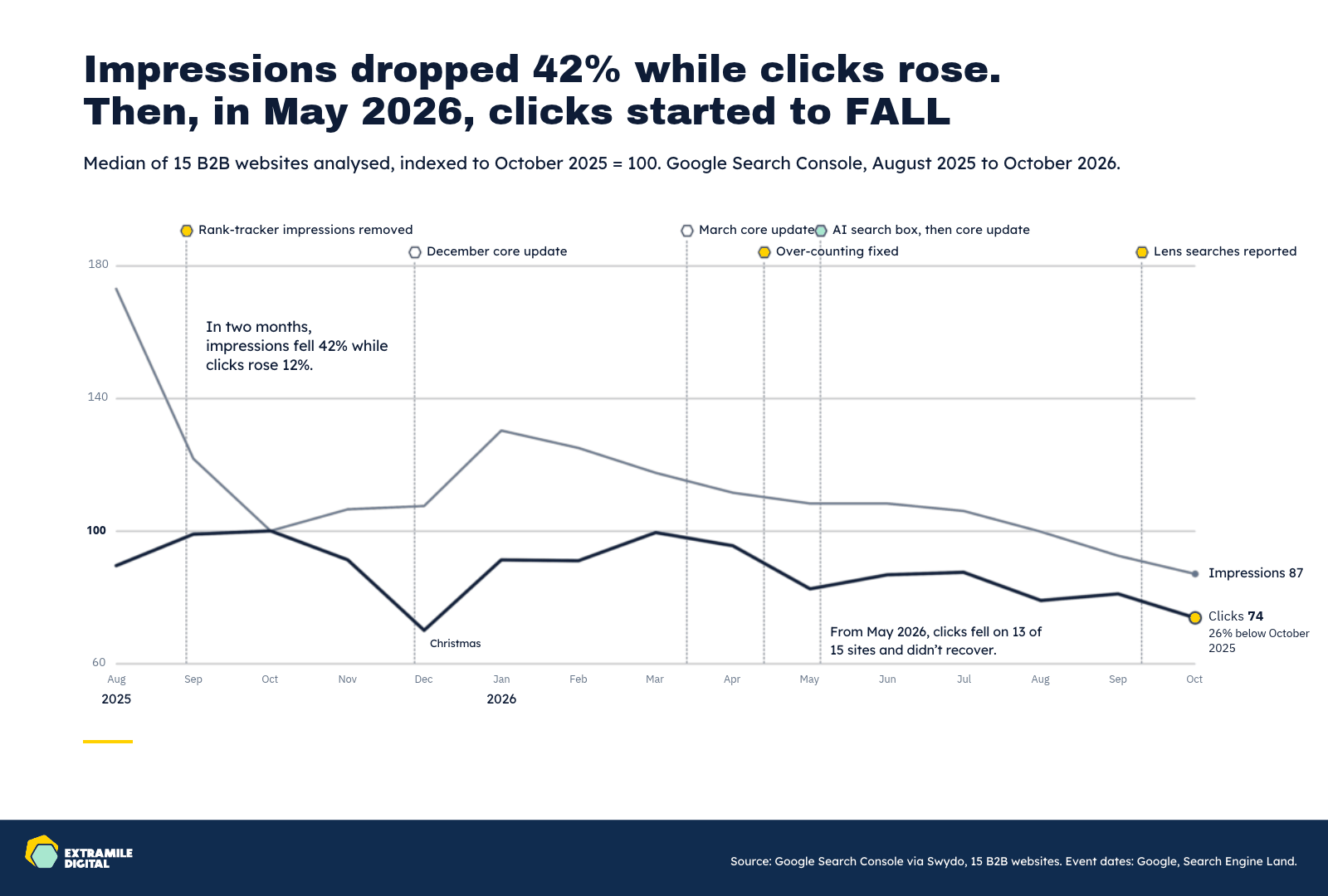
September 2025. Google stopped supporting a setting that tools used to load 100 results at once (Search Engine Land). Those tools had been generating impressions that no person ever saw. When they went, impressions fell on all 15 websites in a single month, by a median of 25%. Clicks rose for 14 of them. We flagged it in our clients’ reports at the time, because a 25% drop in impressions with no explanation tends to make people nervous.
May 2025 to April 2026. Google confirmed that a logging error had stopped Search Console reporting impressions accurately for almost a year. It was fixed on 27 April 2026, but the old data was not corrected. In the week of 20 April, average position worsened on every one of the 15 websites we analysed. Clicks barely moved.
The consequence is simple. Year-on-year comparisons of impressions will not be clean until May 2027, as Summit has pointed out, and click-through rate and average position are calculated from them. That includes the position figures above. Clicks were not affected by either change, which is why this analysis is built on them. So if you’re looking at a year-on-year impressions chart before then, you’re right to raise an eyebrow.
What changed again in May 2026
On 19 May 2026, Google launched a rebuilt search box designed for longer, conversational questions. It also let people carry on from an AI Overview straight into AI Mode, which it says now has more than a billion monthly users. A core update began two days later. It was a busy week.
In the weeks either side, clicks fell on 10 of the 15 websites while average position improved on 13. By autumn, the usual post-summer recovery hadn’t arrived. Clicks rose between August and October on 13 of the websites in 2025, and on only five in 2026.
We can’t prove one caused the other. Two changes landed in the same week, and summer is always quieter in B2B. The timing is still hard to ignore.
Why GA4 and Search Console no longer agree
On 9 of the 15 websites, GA4 and Search Console disagreed about the size of the year’s change by 10 percentage points or more. Two things sit behind that.
- Cookie consent. Visitors who decline analytics cookies aren’t counted. GA4 can estimate them, but only for websites with around 1,000 consenting users a day. Thirteen of the 15 websites are below that, which is normal for a specialist manufacturer.
- AI visits are filed in new places. GA4 added an AI Assistant channel in May 2026 for tools such as ChatGPT and Copilot. Google’s definition excludes its own AI Overviews and AI Mode, which still count as organic search.
The rules are moving too. ICO guidance now describes an exception that allows some analytics without consent, under strict conditions. It’s worth raising with whoever looks after your compliance.
As for AI assistants replacing lost search traffic: not yet. The 12 websites that lost organic sessions gained back about 5% of them from AI assistants.
Fewer visits, better visitors
Here’s the upside nobody puts in the headline. When a buyer asks an AI tool a question, the tool does the legwork. It reads the pages, compares the options and explains the trade-offs. By the time that buyer clicks through to a website, they’re not browsing. They’re checking whether they’ve found the right supplier.
Picture an engineer asking for highly niche, technical information on a specific material or product. A few years ago, that meant an afternoon of searching, a dozen open tabs and a pile of datasheets. Now an AI Overview or ChatGPT session summarises the options in seconds and cites a handful of sources. If your page is one of them, you’re on the shortlist before the buyer has visited a single website. If it isn’t, you may never know you were in the running.
Adobe’s tracking of US retail websites found that in July 2026, visitors referred by AI converted 60% more often than other traffic. They were 14% more engaged, spent 59% longer on site and were 34% less likely to bounce.
Of course, retail isn’t B2B, but B2B data points the same way. Orbit Media’s study of 97 B2B websites found that visitors from AI were three times more likely to become a lead than visitors from other organic sources, and the pattern held on about two-thirds of the sites individually. Yet AI sent just one visit in every 200. ChatGPT turned 2.1% of its visitors into leads, against 0.5% for Google Search, but Google sent 100 times as much traffic.
We’ve seen the same pattern on many of the websites we analysed. On one, 540 AI visits produced 93 key actions, such as enquiries and downloads, about 17 in every 100, against 6 in every 100 from organic search. On another, AI visitors were five times more likely to act, though from far fewer visits. Granted, organic visitors continue to come out ahead in other cases, so how much AI visitors outperform depends heavily on the website and the industry it sells into.
Also, GA4 doesn’t see all of it. Its AI Assistant channel only catches visits that arrive with a referrer from tools such as ChatGPT. Clicks from Google’s own AI Overviews and AI Mode are recorded as organic search, and visits from AI mobile apps often lose their referrer and land in Direct. Anyone who declines cookies isn’t counted at all, and neither is the buyer who saw your name in an AI answer and searched for you later. Whatever GA4 says about AI traffic, the real figure is likely to be higher.
Questions get answered. Buyers still click
One of the biggest impacts, particularly in the case of AI Overviews, is clicks being eaten by the SERP. However, not every search loses clicks equally. It depends on what the person searching actually wants.
Informational searches, the “what is”, “how does” and “why” questions, are exactly what AI summaries are built for. In the Pew Research Center’s study of US Google users, 60% of searches starting with question words such as “what” or “why” produced an AI summary, against 8% of one- or two-word searches. Ask a “what is” question about almost any material or process, and the answer is sitting at the top of the page. There’s not much left to click for.
We see the same pattern across our clients’ accounts. Informational searches often don’t lead to a click, at least not straight away, because the AI summary has already answered the question.
Commercial searches behave differently. Someone looking for a UK supplier of a specific component, or comparing manufacturers for a particular application, needs a datasheet, a price or a person to talk to. An AI Overview can help them build a shortlist, but it can’t send a quote (at the time of writing). Those searches still lead to clicks, and they’re the ones that turn into enquiries.
That doesn’t make informational content a waste of effort. A citation on an early “how does it work” question puts your name in front of a buyer months before they’re ready to talk to anyone. When they get to the commercial search, they’ve already met you. The click just comes later, and sometimes through a different door.
The line is moving, mind. Semrush found that AI Overviews on commercial-intent results grew 71% in the six months to April 2026. So we’d judge the two types of page differently: informational content on how often it’s cited, commercial pages on clicks and enquiries.
AI search isn’t a new discipline. It’s SEO, evolved
There’s no shortage of new acronyms right now: AEO, GEO, LLMO. You’d be forgiven for thinking this was a bad rendition of Old MacDonald.
When Google published its guidance on generative AI search in May 2026, its answer to whether SEO still matters was a short and cheerful yes. It explained that its AI features are built on the same core ranking and quality systems as normal search. Its documentation on AI features goes further, saying there are “no additional requirements to appear in AI Overviews or AI Mode” and no special optimisations needed.
What has changed is the emphasis. Ranking on page one used to be the finish line. Now it’s one of several ways into the answer, and as we saw earlier, only 38% of pages cited in AI Overviews also rank in the top 10. In our experience, AI tools favour pages that answer a specific question clearly, show real expertise, and are easy for a machine to read and trust. That’s good SEO. It always was. It just matters more now that the first reader might be a machine.
For technical B2B businesses, that plays to your strengths. Datasheets, application guides, specifications and honest comparisons are exactly what AI tools need to give a good answer. That’s why we treat AI Search as part of SEO, not an optional extra. Essentially, it’s the same foundations, built with the answer in mind, and checked against every change Google makes. Ironically, as machines take over the search engines, human first, original content is what performs best.
What this means if you sell to technical buyers
For manufacturing, engineering, chemical and defence businesses, where a sale can take a year or more, we’d change four things.
- Stop judging SEO on impressions and average position. Treat May 2026 as your new baseline, and mark the changes above on your reports.
- Judge it on clicks and, above all, enquiries. Take enquiries from your CRM, not from analytics events.
- Measure whether you’re in the answer. Forrester reports that 94% of business buyers now use AI during the buying process. If a shortlist forms inside an AI answer, being cited there matters as much as ranking. Search Console’s Generative AI report shows how often your pages appear.
- Keep investing in depth. In our view, specific technical pages are the ones that earn citations: datasheets, application guides and honest comparisons.
Search hasn’t stopped working for B2B. The way it’s counted has changed, and reports need to catch up.
We’ll keep tracking whatever Google changes next, and keep our clients’ strategies in step with it. If your reports are raising more questions than they answer, our B2B SEO and data and analytics teams can help.